


Walks, legends and megaliths within cycling distance
Everything you need to know (or almost know) about visiting the Carnac alignments
The Carnac alignments: 3,000 menhirs to discover
Europe’s largest megalithic site
Located in Brittany’s Morbihan region, the Carnac megalithic site is a 7,000-year-old mecca of European prehistory. The Carnac alignments are one of Europe’s best-known megalithic complexes, alongside Stonehenge in England.
DID YOU KNOW? The origins of Carnac are lost in the mists of time. The name “Carnac” derives from the Celtic CAIRN or CARN, meaning mound or elevation.
Discover almost 3,000 menhirs, dolmens, tumuli and other Neolithic relics stretching for around four kilometers between Plouharnel Bay and the Trinité-sur-Mer river. Their height varies from 45 cm to 6 metres. Most are still standing, some are lying down, others are hidden under vegetation.
The application to have the Megalithic Alignments listed as a UNESCO World Heritage Site is well underway. Indeed, this incredible historic site brings together several distinct sites:
- the Menec alignments
- the Kermario alignments
- the quadrilateral and the Manio Giant
- the Kerlescan alignments
- the Petit Menec alignments
Not forgetting the Kerzhero alignments in nearby Erdeven, the Locmariaquer site (tumulus and broken menhir) and all the isolated alignments to be discovered on your walks.
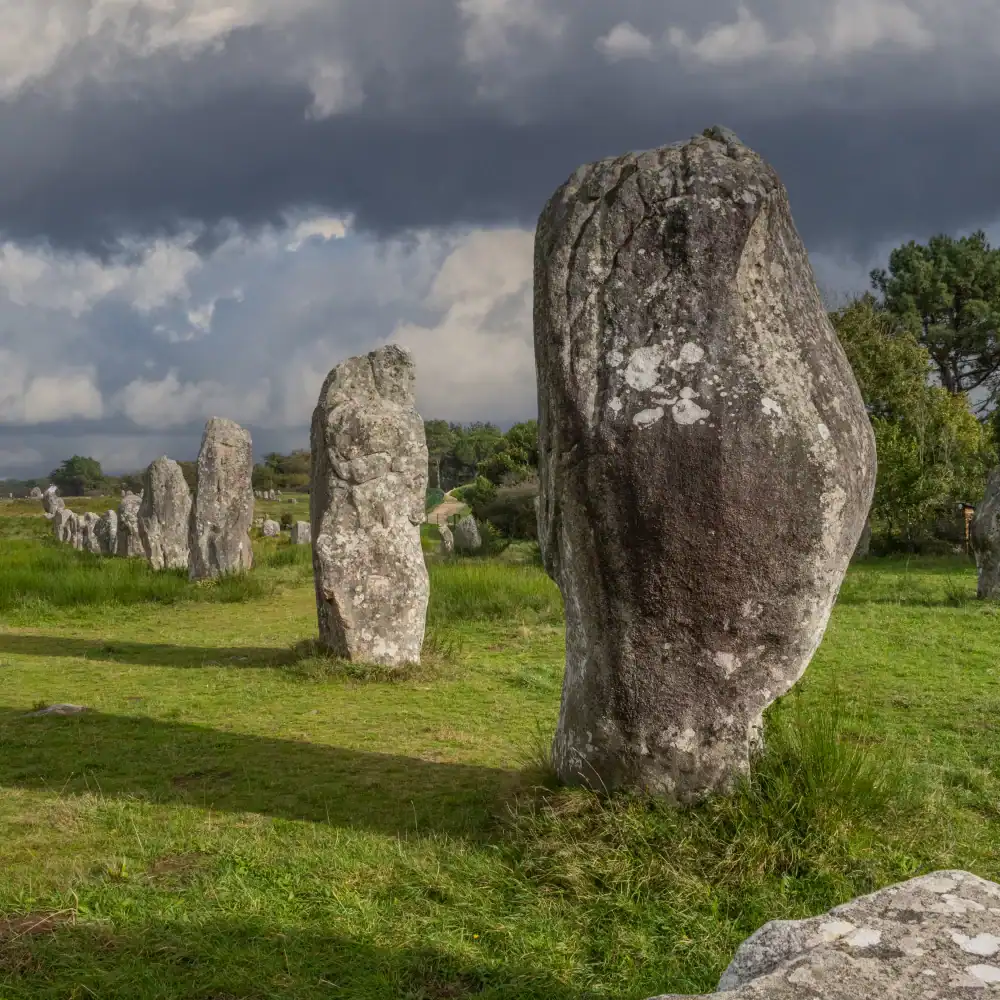

Why these stones? The mystery remains!
The secrets of Breton menhirs
Despite numerous hypotheses, no one can say with certainty what the menhirs of Carnac represent. Religious monuments, alignments according to the sun or moon, or the myth of a Roman army transformed into stones…. It would seem, however, that these alignments had a sacred and funerary function. From Saint Cornély to visitors from outer space, there are almost as many legends about Carnac as there are menhirs!
Astronomical hypothesis
The most plausible hypothesis, given current knowledge, is that the Carnac alignments served as an astronomical observatory. As the menhirs were positioned to follow the movements of the sun, moon and stars, the site could have been used to mark solstices, equinoxes and other important celestial events, perhaps as part of religious or agricultural rituals. This hypothesis underlines the link between prehistoric man and his understanding of the universe.
The legend of the petrified Roman soldiers
Many legends surround the Carnac alignments. One of them tells of a regiment of Roman soldiers petrified by Cornély, pope from 251 to 253. Each menhir is said to be a soldier of the Roman legion, turned to stone for eternity because of their wickedness or lack of faith. Saint Cornély, patron saint of horned animals, became the patron saint of the town of Carnac.
The ancient astronaut theory
According to this unscientific theory, the menhir alignments at Carnac were created by extraterrestrial visitors thousands of years ago. These advanced beings would have used their technology to erect the menhirs to mark their passage on Earth, or to serve as landmarks or beacons for interstellar navigation. The menhirs would follow the Earth’s magnetic field.
The objects discovered during the excavations are on display at the Musée de la Préhistoire in Carnac (Centre Ville). The site is in the process of becoming a UNESCO World Heritage Site.
The objects discovered during the excavations are on display at the Musée de la Préhistoire in Carnac (Centre Ville). The site is in the process of becoming a UNESCO World Heritage Site.
Download the map of these alignments by clicking here